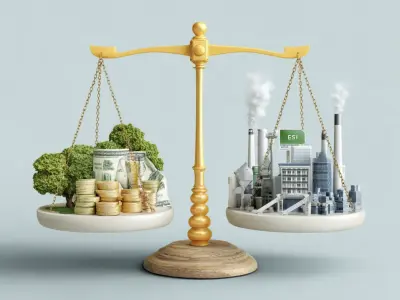
Best Practices from the Field: Smart Manufacturing Success Stories

Smart manufacturing is getting more interesting not only in high-income economies; the trends have been arriving in emerging economies and in small, resource-constrained factories. Across India and worldwide, factories are using data, connectivity and AI to lift productivity, compress lead times, and cut energy and Greenhouse Gas (GHG) emissions, all at once.
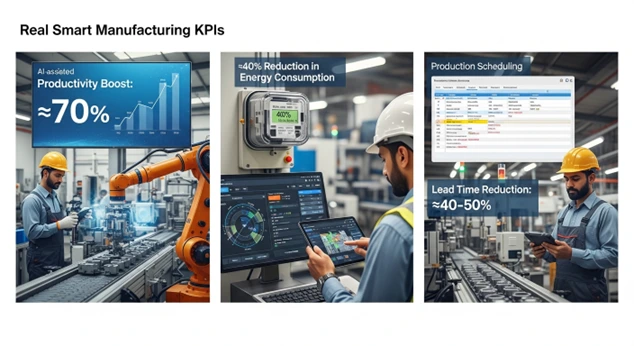
The World Economic Forum’s Global Lighthouse Network (GLN) now documents dozens of plants that have scaled Fourth Industrial Revolution (4IR) technologies with hard, audited results, often double-digit improvements across cost, quality, and sustainability. According to the World Economic Forum, recent GLN syntheses sites achieving productivity gains of up to ~70%, energy cost reductions around ~40%, and time-to-market cuts of ~40% after scaling digital solutions end-to-end.
Why Smart Manufacturing Matters
Global supply chains are under pressure, energy costs are rising, and sustainability mandates are tightening. Smart manufacturing has become a competitive necessity. Companies that digitize now gain agility, resilience, and cost advantage.
Key Benefits Snapshot
-
Productivity Gains – For example, according to World Economic Forum, Siemens Erlangen factory achieved a 69% productivity boost after implementing AI, digital twins, and robotics under the Global Lighthouse Network framework.
-
Energy Savings - The same Siemens case reported a 42% reduction in energy consumption, aligning with WEF Lighthouse sustainability benchmarks.
-
Lead Time Reduction - McKinsey’s analysis of Global Lighthouse Network sites shows a 48% reduction in lead times on average after scaling Fourth Industrial Revolution technologies. Below we highlight three stories, then distill a practical playbook you can use to get started or go further.
Case 1 — One IoT Backbone: ~130 Factories “As If Under One Roof”

DENSO decided to develop its Factory-IoT platform in-house and connect about 130 production factories worldwide. The company describes the concept as operating “as if under one roof,” even though the sites span multiple regions and equipment vendors. Building the platform internally ensured common data plumbing from PLC signals at the edge to applications in the cloud—and allowed DENSO to standardize how events, states, and production contexts are captured and reused across plants.
From an engineering perspective, DENSO has also explained why it leaned on managed Kubernetes services (e.g., GKE/EKS/AKS): to unify runtime environments and shorten the cycle time for new factory apps from months to weeks while keeping a slower, safety-first cadence for critical features. In DENSO’s words, this approach enables frequent prototyping and packaged rollouts without fragmenting the stack.
Case 2 — Designing and Running Energy-Smart Production (Linking Motion and Power)
DENSO’s production-engineering articles describe a clear principle: record plant operations in real time, including both equipment movement and power consumption, then act on the linkage. When these signals are analyzed together, engineers can identify how energy peaks relate to specific equipment motions and production schedules and use those insights to inform process settings and production planning. The same linked data supports CO₂ estimation at the design stage, enabling carbon-aware decisions before a line goes live. Remote visualization and related digital tools further help shorten on-site work and reduce rework.
Kaizen IoT: Connect, See, Improve—All on One Platform
Kaizen IoT is a platform that offers data-driven integrated manufacturing solutions through IoT and AI to tackle legacy systems, high costs, predictive maintenance, automation, and compliance management. It connects equipment, lines, warehouses, and enterprise systems (ERP/MES) through a universal gateway, then delivers real-time monitoring, plan-vs-actual loss visualization, and video-linked root-cause analysis on a single screen.
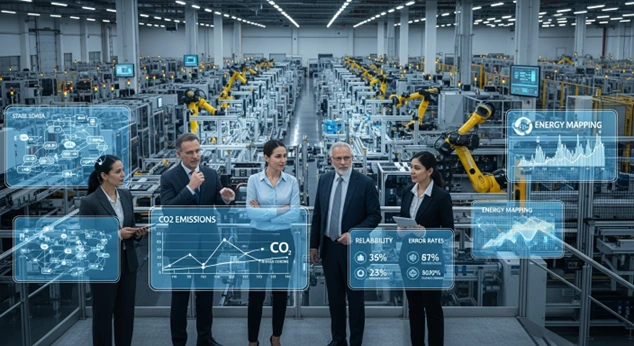
Beyond dashboards, it supports the kaizen loop end-to-end which helps us understand the current factory situation quantitatively for CEOs, Operations, Quality, and Production managers.
The result is practical value where it matters: earlier visibility of hidden losses, faster containment and corrective actions, fewer handoffs between teams, and measurable improvements in throughput, yield, and on-time delivery, while optimizing energy and service costs. Adoption can start small (one line or process) and scale plant-wide without re-engineering, thanks to reusable connectivity patterns and a common data model. In short, Kaizen IoT makes digital transformation tangible by converting everyday production events into reliable, repeatable performance gains.
Alongside the Kaizen IoT platform, we also provide a comprehensive Capacity Building program. This program goes beyond system operation training, it covers advanced topics in manufacturing such as what Smart Manufacturing truly means, and how Carbon Footprint Management should be effectively implemented. Through this, we aim to build both digital capabilities and strategic understanding within manufacturing organizations.
Challenges & How to Overcome Them
- Legacy Systems: Start with modular IoT gateways and APIs.
- Skills Gap: Invest in workforce upskilling and digital literacy.
- Cybersecurity: Adopt zero-trust architecture and secure cloud-native platforms
Closing Thought
For manufacturers weighing how to modernize lines in India or elsewhere, DENSO’s cases offer a clean lesson: build a repeatable data + engineering backbone, integrate energy signals from day one, and make network reliability a production concern. You don’t need to invent a new playbook, copy the parts that are publicly proven, and adapt them to your processes and people.
Sources
- World Economic Forum, Kiva Allgood, “Supply chain and manufacturing transformation: Key takeaways from Davos 2025”, 30 Jan 2025
- Robotics Business News - Siemens Erlangen Factory Joins World Economic Forum’s Global Lighthouse Network
- McKinsey - The continuing evolution of the Global Lighthouse Network
- World Economic Forum - Smart, sustainable manufacturing: 3 lessons from the Global Lighthouse Network
- DENSO, Driven Base, “To Achieve Environment-friendly Manufacturing through the Smart Use of Energy”, 8 Dec 2023
- DENSO, “DENSO Developed Factory-IoT Platform to Link 130 Factories Worldwide”, 5 Oct 2020
Explore more
From Paper to Platform: Why It’s Time to Digitize Vehicle Inspections
Explore how digital transformation is revolutionizing manufacturing processes, from IoT integration to AI-powered analytics and smart factory implementations.
How Carbon Footprint Management Drives Corporate Financial Performance
How Carbon Footprint Management Drives Corporate Financial Performance