
Why Regular Vehicle Maintenance Matters
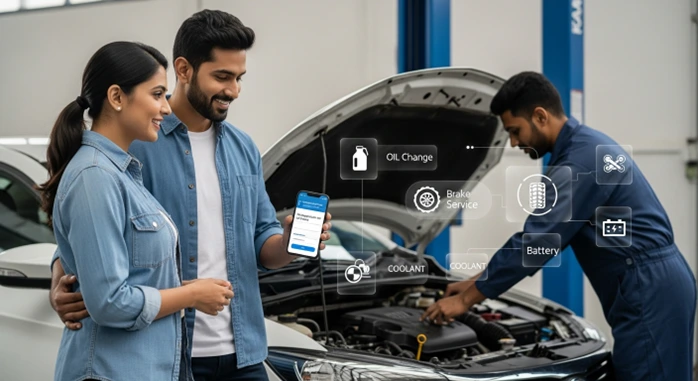
Keeping a business fleet running is a numbers game: uptime, cost control, and customer trust. Unplanned stoppages turn into missed deliveries, penalty fees, and lost bookings. Small issues like thinning brake pads, low fluids, worn belts, and weak batteries grow quietly until a vehicle is sidelined on a busy day. A planned maintenance routine turns those surprises into scheduled shop time. It protects drivers, keeps vehicles compliant, and holds total cost of ownership in check.
Focus on outcomes that move the P&L. Vehicles to be made available when scheduled. Predictable service intervals and parts spend. Fewer emergency repairs. Longer replacement cycles. Digital tools make this simple by synchronizing service to mileage, engine hours, and fault codes. They send alerts before parts fail, help you book the right job at the right time, and keep an audit trial for every unit. Regular maintenance delivers the fundamentals of a healthy fleet: uptime, cash flow, and reliable service.
Why maintenance matters, and what “routine” really means
Open the owner’s manual and follow the time or mileage intervals lists. Most cars need regular attention to engine oil and filter, air and cabin filters, brake fluid, coolant, plugs, and transmission fluid. Check tires monthly for pressure and tread. Look at wiper blades and exterior lights. Pop the hood and glance at coolant and battery terminals. If you tow, crawl in traffic, drive in high heat, or make short winter trips, use the “severe duty” intervals. Those conditions speed up wear.
Do not wait for warning lights to guide everything. Warning lights catch serious faults. Routine service keeps the car from reaching that point. Preventive work is cheaper than corrective work. A 100 Rupee filter can protect a 6000 Rupee component. A belt replaced on time saves an alternator. Dry brake fluid lengthens stopping distance; a simple flush resets it.
What you gain (briefly):
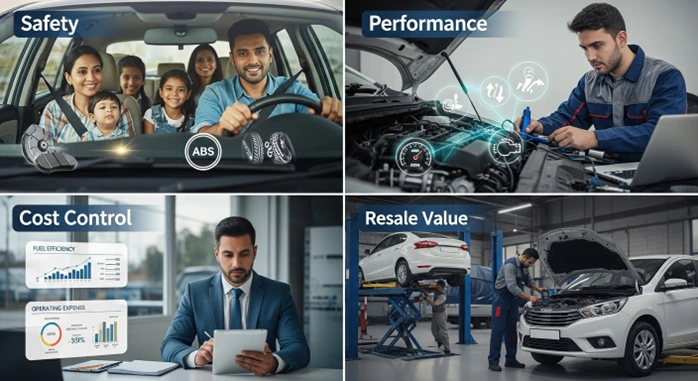
- Safety first: Fresh brake pads/fluid shorten stopping distance; good tires keep grip in rain; tight suspension keeps the car tracking straight.
- Performance & efficiency: Clean oil and filters reduce friction and stabilize airflow/fuel; healthy cooling prevents power pullback; result is smoother, quieter, more economical driving.
- Lower total cost: Small, timed fixes avoid big failures—a 100 Rupee filter can protect a 6000 Rupee part; a belt on time saves alternator/pump; sealing a minor leak protects the catalytic converter.
- Resale value: Invoices or digital log signal care. That proof often bumps a car from average trade-in to top-tier pricing and eases warranty claims.
What counts as “routine”?
Follow the intervals in your owner’s manual: engine oil and filter, air and cabin filters, brake fluid, coolant, transmission fluid, spark plugs. Add a quick monthly check of tire pressure/tread, wipers, exterior lights, coolant levels, and battery terminals.
Harsh driving conditions accelerate wear. Preventive work beats corrective work. Do not wait for warning lights; they signal serious faults. Routine service keeps the car from reaching that point.
Digital tools that make it easy

Tracking “what and when” is the hard part. A good app turns it into a quiet checklist that runs in the background.
- Personalized schedules: Store VIN, history, and odometer readings
- One-tap booking: See real workshop slots, transparent estimates, parts availability; share history to avoid duplicate work.
- Digital service record: Scan invoices, attach photos, keep warranties together; export when selling or switching shops.
- Multi-vehicle support: Manage family cars separately without mixing dates.
- Data control: You own the record; access / download anytime.
Getting started is quick: add your car, enter current mileage and typical monthly distance, then book the next service. From there, the tool does the memory so you can focus on the road.
A simple plan you can keep
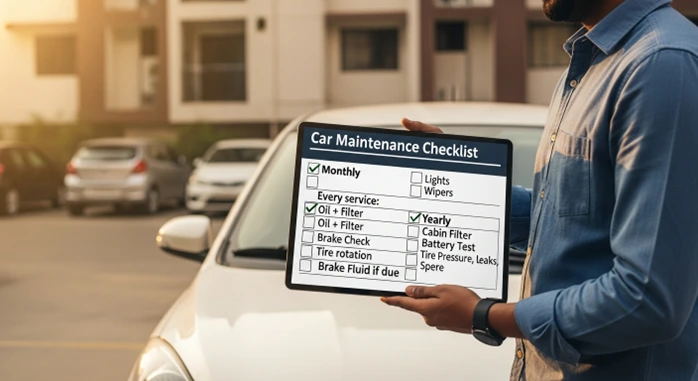
- Every month: check tire pressure and tread, top up washer fluid, glance at lights and wipers.
- Every service: change oil and filter on time, inspect brakes, rotate tires, check coolant and belts.
- Every year: replace cabin filter, test battery health, flush brake fluid if due.
- Every long trip: check tire pressure when cold, look for leaks, confirm spare kit.
Know the early signals. Squeal or vibration while braking. A pull to one side. A warm smell after a short drive. Coolant level dropping week to week. Any check engine light. These are small problems asking for attention. Quick action keeps the fix simple.
Regular maintenance is not a chore to fear. It is a brief list, done on time, which keeps your car safe, responsive, and economical. And when the time comes, use the Solwer Customer app to meet your vehicle’s service needs.
Explore more
Why Carbon Footprint Management is Becoming a Business Imperative
Manufacturers are at the forefront of the global effort to reduce carbon emissions. What was once a voluntary sustainability initiative has evolved into a non-negotiable business requirement. Today, managing carbon emissions is not optional—it is a strategic necessity that directly influences market access, brand equity, and long-term business resilience.

The Basics of Vehicle Digital Inspection: What It Is and How It Works
Discover how digital transformation is revolutionizing vehicle inspection processes, improving efficiency, accuracy, and compliance while reducing costs and environmental impact.